FREE ASSET MANAGMENT TRAINING IN BC:
Leveraging Your Asset Data
This is a free online course for Local BC Governments and First Nations about Leveraging Your Asset Data.
Infrastructure owners often have a lot of asset data flying around. A spreadsheet here, a system there, and even printed binders on site… Too many organizations are not using those valuable data assets to support planning and decision-making efforts. It’s time to start Leveraging Your Asset Data.
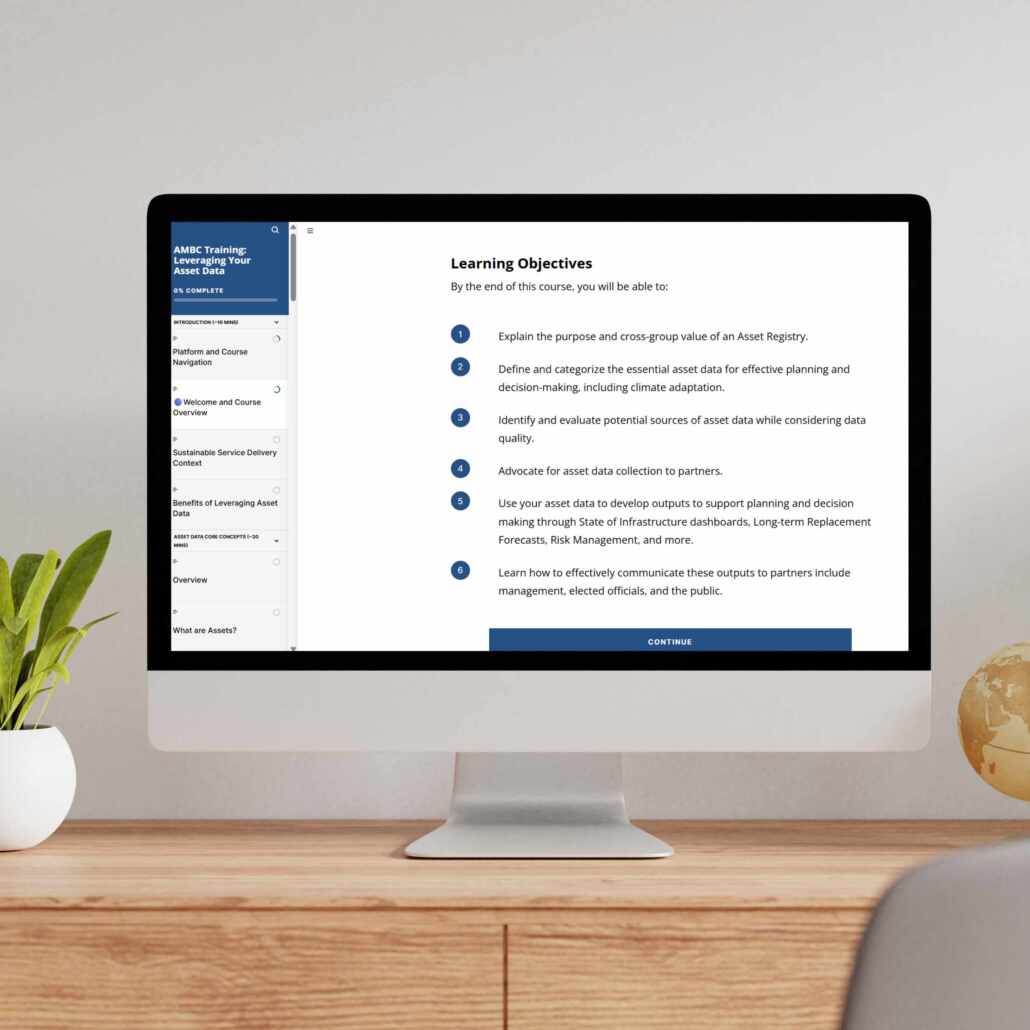
This 2-hour eLearning course is going to give anyone involved in public infrastructure the knowledge and tools to analyze, interpret, and apply asset data effectively.
We want to help you understand how to setup an Asset Registry, the essential data you should be collecting, and how you can leverage that data to develop and communicate State of Infrastructure Reports, Long-term Replacement Forecast, and more.
Know what you have so you can plan for what you need. Learn how to build an asset registry, assess infrastructure conditions, and use data-driven insights to improve long-term planning, budgeting, and service reliability. Get the tools to secure funding and make the case for infrastructure investments.
Note: Learners will receive course emails from icInfrastructure, our training partner.
This 2-hour online training may qualify for Professional Development (PD) or Continuing Education Development (CED) credits, subject to your professional association’s approval. For assistance, contact [email protected].
“Course content was very well presented, complete with practical resource downloads, testimonies from local practitioners in the field, and simple tests to help with retention of all the valuable concepts shared. It’s also free and learning is self-paced; course completion took just a few hours. I am all the more equipped to connect with my organization’s stakeholders as I lead the charge to build up the Town of Sidney’s Geospatial Data Registry.”
– Jesse Joe
Geospatial Analyst, Town of Sidney
Register Now:
Course Content
Online training will cover the following:
- Module 1 – Introduction: Welcome to the Course
- Module 2 – Asset Data Core Concepts:
- Module 3 – Leveraging Your Asset Data:
- Module 4 – Implementing an Asset Registry:
- Module 5 – Summary: Gain free resources to help you along your Asset Management Journey.
Why Attend?
- Learn with peers across BC in a virtual, time-bound program.
- Practical focus with real-world examples and applicable tools.
- Flexible format with guided sessions and open conversations.
- Expert facilitation grounded in BC local government experience.
Training Outcomes
- Explain the purpose and cross-group value of an Asset Registry.
- Define and categorize the essential asset data for effective planning and decision-making.
- Identify and evaluate potential sources of asset data while considering data quality.
- Advocate for asset data collection to stakeholders.
- Use your asset data to develop outputs to support planning and decision making through State of Infrastructure dashboards, Long-term Replacement Forecasts, Risk Management and more.
- Learn how to effectively communicate these outputs to stakeholders include management, elected officials and the public.
Who Should Attend
Everyone involved in public infrastructure—including staff, managers, elected officials, vendors, associations, and engaged members of the public.
Frequently Asked Questions
Q: Do I need any prior experience with asset management?
A: No, the course is designed for beginners and those new to local government asset management.
Q: Can I complete the course on my own schedule?
A: Yes, it’s self-paced and mobile-friendly, so you can fit it into your schedule wherever you are.
Q: How do I access the course?
A: The course is online and can be accessed via a web browser or mobile device. Login details will be provided after registration.
Q: Why isn’t my email working when I try to enroll in the course?
A: Learners must use their BC work email to enroll. Please double-check that your email is spelled correctly.
Q: Why didn’t I receive the email to access my course?
A: Emails from the training platform will come from the following email sender [email protected]. Please check your inbox and spam/junk folder. Note: This is a “No Reply” email, if you have training questions, please reach out to [email protected] for assistance.
Q: If I’m experiencing issues with the training or accessing the course, who do I contact?
A: Please reach out to [email protected] for assistance.
Q: Where do I start once I’m enrolled?
A: Begin with Part 1 of the course, then continue to the remaining content. Each part builds on the previous section, so we recommend completing them in order.
Q: Will I receive a certificate?
A: Yes, a certificate of completion will be provided once you finish the course (Parts 1 and 2).
Q: I completed the course, why didn’t a receive my certificate?
A: Please ensure that you’ve completed both parts of the course. You should see a “100% completion” within the course on the navigation panel. If these is not 100% on both parts of the courses, you will need to complete outstanding lessons so the training platform can issue you a certificate.
Asset Data Cohort Sessions
Invitations are going out to attendees for a cohort learning experience that builds on the ideas in the course. The session will be in a group setting and is designed to support students to apply the principles learned in practical setting.
Below is a description of the cohort format:
- The cohort is FREE to communities in BC thanks to funding from FCM and Asset Management BC.
- The cohort will predominantly operate on a first come, first served basis, with equity criteria also considered. If we cannot accept you into the first cohort launching in January/February, or you’re interested in a future cohort, we can add you to a waitlist.
- Up to 3 participants per organization can participate in a cohort. If you’d like to bring a colleague, please let us know.
- Expression of interest doesn’t have to be a firm commitment yet.
If you would like to express your interest in attending an upcoming cohort, or would like more information on the cohort sessions, please send an email to [email protected]
For questions or more information, contact [email protected]
Join our newsletter to be notified of future training opportunities.