FREE ASSET MANAGEMENT TRAINING IN BC:
Community Infrastructure, Climate, and Equity: Training for BC Elected Officials and CAOs
These free courses are available for both Elected Officials as well as local government CAOs & Senior Management in British Columbia.
- Tailored for BC Elected Officials, CAOs, & Senior Leaders—built with input from BC communities.
- Reflects current legislation, provincial priorities, and best practices—with tools, templates, and real-world examples you can use right away.
- A 2-3 hour long course that is online, self-paced, and mobile-friendly to fit into your schedule—wherever you are.
Note: Learners will receive course emails from icInfrastructure, our training partner.
This online training may qualify for Professional Development (PD) or Continuing Education Development (CED) credits, subject to your professional association’s approval. For assistance, contact [email protected].
Community Infrastructure, Climate, and Equity
Training for BC Elected Officials
(Online course)
Make confident, informed decisions about your community’s infrastructure. Learn how asset management practices help you tackle infrastructure challenges, prepare for climate impacts, and ensure fair and sustainable service delivery—all while making the best use of taxpayer dollars.
Community Infrastructure, Climate, and Equity
Training for BC CAOs
(Online course)
Tailored for CAOs and Senior Leaders, this training will help drive better long-term planning and financial sustainability for your municipality. Understand how asset management supports risk management, strategic decision-making, and efficient use of resources to strengthen infrastructure, optimize services, and secure funding.
“With affordability challenges stretching far beyond grocery stores and housing, an important conversation about the responsibility of caretaking community infrastructure is timely. This is a discussion easily delayed in favour of many pressing things, but not facing up to the challenge of keeping our existing systems functional will cost far more later. This course provides an excellent foundation to build competence for elected officials and senior managers.”
– Bill Sims
General Manager, Engineering & Public Works at City of Nanaimo
Course Content
Online training will cover the following:
- Module 1 – Introduction: Welcome to the Course*
- Module 2 – The Perfect Storm: Learn how Canada and BC’s infrastructure got to it’s current state.
- Module 3 – What is Asset Management?: Learn about the purpose of Asset Management and what are the asset types delivering service.
- Module 4 – Core Concepts of Asset Management: Understand the key components such as Service, Cost, Risk.
- Module 5 – Benefits and Getting Started: Learn the impacts to your community, organization, and staff.
- Module 6 – Summary: Gain free resources to help you along your Asset Management Journey.
* Course customizations included for Elected Officials and Chief Administrative Officers.
Why Attend?
- Strengthen your community’s infrastructure planning.
- Make confident, informed decisions.
- Access tools tailored for BC local governments and First Nations.
- Build skills that support equity and inclusion.
Training Outcomes
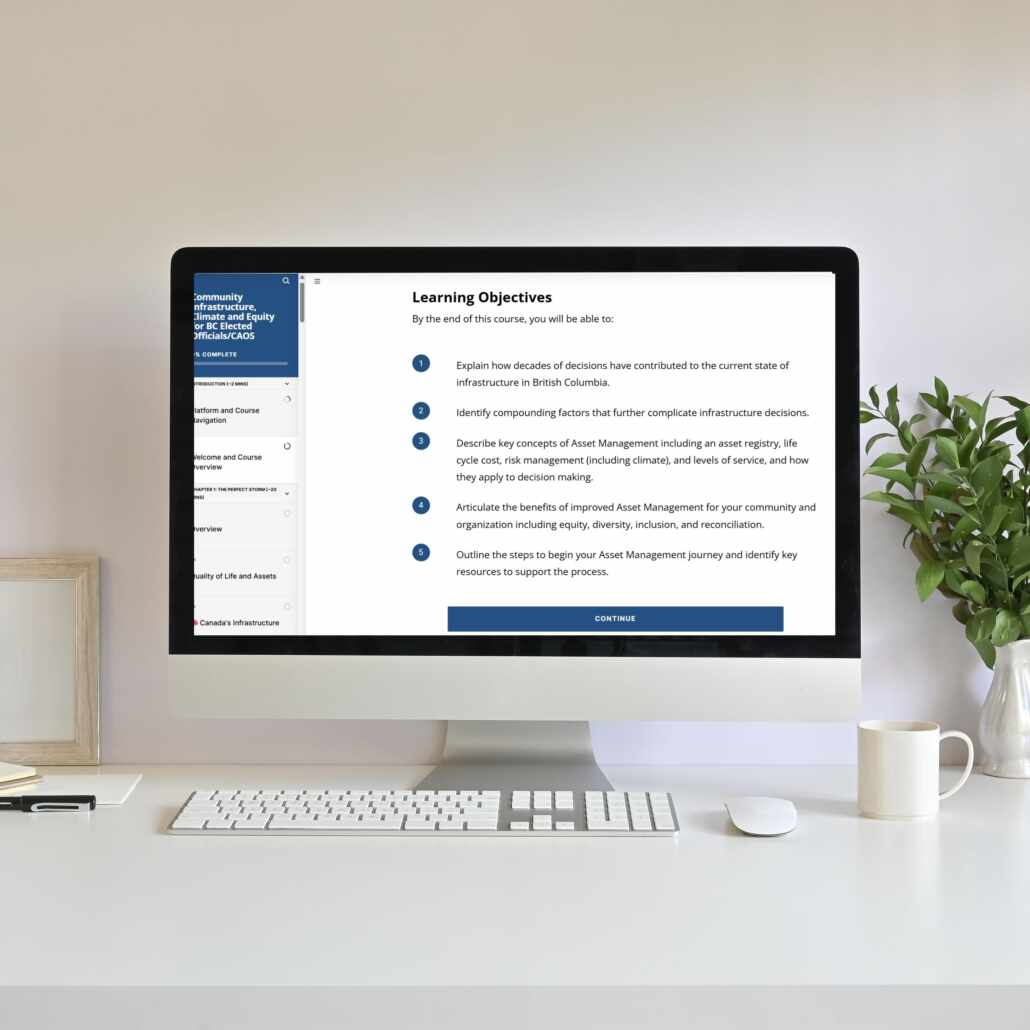
- Explain how decades of decisions have contributed to the current state of infrastructure in British Columbia.
- Identify compounding factors that further complicate infrastructure decisions.
- Describe key concepts of Asset Management including asset registry, life cycle cost, risk management (including climate), and levels of service and how they apply to decision making.
- Articulate the benefits of improved Asset Management practices for my community and organization including equity, inclusion and reconciliation.
- Outline the steps to begin your Asset Management journey and identify key resources to support the process.
Who Should Attend
These online courses are tailored for Local BC Governments and First Nations.
Elected Officials, Staff, and Senior Management in British Columbia will build a strong foundation for better decision-making by understanding how risk management, infrastructure conditions, and long-term planning impact their ability to sustainably deliver community services while considering equity and climate challenges.
Frequently Asked Questions
Q: Do I need any prior experience with asset management?
A: No, the course is designed for beginners and those new to local government asset management.
Q: Can I complete the course on my own schedule?
A: Yes, it’s self-paced and mobile-friendly, so you can fit it into your schedule wherever you are.
Q: How do I access the course?
A: The course is online and can be accessed via a web browser or mobile device. Login details will be provided after registration.
Q: Why isn’t my email working when I try to enroll in the course?
A: Learners must use their BC work email to enroll. Please double-check that your email is spelled correctly.
Q: Why didn’t I receive the email to access my course?
A: Emails from the training platform will come from the following email sender [email protected]. Please check your inbox and spam/junk folder. Note: This is a “No Reply” email, if you have training questions, please reach out to [email protected] for assistance.
Q: If I’m experiencing issues with the training or accessing the course, who do I contact?
A: Please reach out to [email protected] for assistance.
Q: Where do I start once I’m enrolled?
A: Begin with Part 1 of the course, then continue to the remaining content. Each part builds on the previous section, so we recommend completing them in order.
Q: Will I receive a certificate?
A: Yes, a certificate of completion will be provided once you finish the course (Parts 1 and 2).
Q: I completed the course, why didn’t a receive my certificate?
A: Please ensure that you’ve completed both parts of the course. You should see a “100% completion” within the course on the navigation panel. If these is not 100% on both parts of the courses, you will need to complete outstanding lessons so the training platform can issue you a certificate.
Overlapping Course Content
Both of these courses offer valuable information on asset management concepts for Community Infrastructure, Climate, and Equity and are resources for all community staff. The courses share the common themes:
- The Essential courses cover all the basic/main terms in Asset Management: life cycle costs, service, risk management, assets (asset registry), EDI, and climate adaptation.
- Both courses share the same foundational principles of Asset Management but the Elected Officials (EO) version includes governance-specific context and examples.
The course for elected officials has a more specific focus on governance related to asset management and highlights the following information:
- We acknowledge that elected officials may have different goals during their terms and understanding AM helps accomplish those goals, their duty to manage responsibly, and how best to use a 4-year window to influence infrastructure problems.
- There are references to the Municipality and regional district information/terminology in the Community Charter Section 7, Local Government Act Sec. 185 that mention the “purposes of a municipality” and “purposes of regional districts”.
- The course explains service delivery from an elected official perspective.
- There are planning concepts as they relate to elected official responsibilities.
There are no restrictions on community staff enrolling in both courses and if staff would like a better understanding of the information in the elected official training, we would encourage them to enroll in both courses.
For questions or more information, contact [email protected]
Join our newsletter to be notified of future training opportunities.